
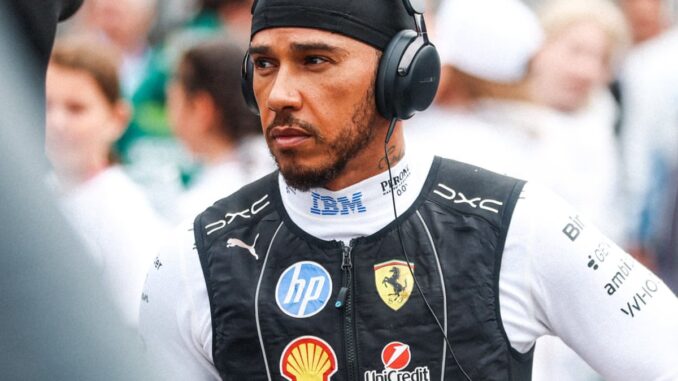
Lewis Hamilton’s frustration with Ferrari boiled over at the Dutch Grand Prix, with the seven-time world champion making it clear that he believes his team left valuable time—and potentially a podium finish—on the table.
Hamilton finished fourth at Zandvoort as Lando Norris took victory ahead of Mercedes’ Kimi Antonelli and George Russell. But the result did not tell the entire story from Hamilton’s perspective.
The Ferrari driver believed he had the pace to challenge for a podium, particularly because he was running a different tyre strategy from teammate Charles Leclerc. Instead, Hamilton spent crucial moments behind Leclerc while Ferrari hesitated over what to do.
And that frustration became impossible to hide.
HAMILTON DELIVERS A BLUNT MESSAGE TO FERRARI
Hamilton’s frustration came over the team radio when Ferrari eventually pitted Leclerc.
“Great way of wasting time, good job,” Hamilton told the team.
It was an unusually direct message from the British driver and underlined just how much he felt the decision had cost him.
Hamilton later explained that he had watched Mercedes handle a similar situation much more efficiently.
With Antonelli running on faster, fresher tyres late in the race, Mercedes quickly instructed Russell to allow his teammate through rather than allowing the two drivers to fight and potentially lose time.
From Hamilton’s perspective, that was exactly what Ferrari should have done.
The difference may have been only a handful of seconds, but at Formula 1 level, seconds can completely change the outcome of a race.
WHY THE LECLERC DECISION MATTERED
Hamilton and Leclerc were competing under different circumstances because of their tyre strategies.
That created a situation where Ferrari had to decide whether protecting Leclerc’s position was more important than allowing Hamilton, who appeared to have greater pace at that moment, to maximize his opportunity.
The team eventually made the call, but Hamilton believes it came too late.
That is important because Hamilton wasn’t simply asking Ferrari to favor him for no reason. His argument was based on the wider championship picture.
If one Ferrari driver is significantly faster because of tyre advantage, keeping both cars fighting each other can potentially allow rival teams to gain an advantage.
Mercedes recognized that with Antonelli and Russell.
Ferrari, according to Hamilton, did not react quickly enough.
MERCEDES SHOWED FERRARI HOW IT CAN BE DONE
The contrast between the two teams was one of the most interesting aspects of the Dutch Grand Prix.
Russell admitted that Mercedes’ decision was not necessarily easy from a driver’s perspective. Every driver naturally wants to fight for every position.
But Russell also understood the bigger picture.
Antonelli was already ahead and had the benefit of newer tyres. Mercedes believed Antonelli would eventually get past anyway, so allowing the faster car through immediately prevented unnecessary time loss.
That is exactly the kind of decision that can matter over an entire championship.
Toto Wolff also defended Mercedes’ approach, describing it as a straightforward decision based on rules the team had already discussed internally.
HAMILTON KNOWS EVERY POINT MATTERS
The bigger concern for Hamilton is the championship.
Antonelli’s second-place finish strengthened his position at the front of the championship battle, while Hamilton and Russell are now 59 points behind the Italian.
That makes every lost opportunity increasingly important.
A fourth-place finish is still a strong result, especially in a championship as competitive as Formula 1. But Hamilton’s frustration comes from believing that fourth may not have been Ferrari’s maximum achievable result.
A podium would have delivered additional points and momentum.
Instead, Hamilton left Zandvoort wondering what might have happened if Ferrari had acted earlier.
FERRARI CANNOT AFFORD TO WASTE OPPORTUNITIES
There is a larger issue here for Ferrari.
The team doesn’t necessarily need to have the fastest car at every circuit to compete for championships. It needs to maximize the opportunities it gets.
That means making fast strategic decisions.
It means managing teammates effectively.
And, perhaps most importantly, it means ensuring that drivers do not lose points because of avoidable internal delays.
Hamilton’s comments suggest that he believes Ferrari has more potential than the results are currently showing.
That is potentially encouraging—but also a warning.
A driver of Hamilton’s experience knows that championship battles are often decided by small moments rather than dramatic failures.
A few seconds here.
A position there.
A missed pit window.
A questionable strategic call.
Those small decisions accumulate.
HAMILTON’S FERRARI PROJECT IS UNDER PRESSURE
Hamilton’s move to Ferrari was always going to attract enormous attention.
The seven-time world champion joined one of Formula 1’s most famous teams with the expectation that the partnership could produce another championship challenge.
That naturally creates enormous pressure.
Hamilton is not simply trying to finish races and collect points. He wants Ferrari fighting at the front.
His comments after the Dutch GP therefore carry more weight than an ordinary post-race complaint.
He explicitly said that he believes Ferrari can win and that his objective is to help lead the team toward a championship.
But he also acknowledged that the team has work to do.
That combination is significant.
Hamilton doesn’t appear to be questioning Ferrari’s potential. He’s questioning whether the team is executing well enough to turn that potential into results.
WHAT THIS MEANS FOR CHARLES LECLERC
Leclerc is also caught in the middle of the situation.
From his perspective, the priority is naturally to maximize his own result. But when teammates are fighting for positions under different strategies, team orders can become unavoidable.
Ferrari has to find the balance between allowing its drivers to race and protecting the team’s overall championship objectives.
If Hamilton has significantly better pace, holding him behind Leclerc doesn’t necessarily benefit either driver.
At the same time, Ferrari cannot constantly move one driver aside simply because the other is faster at a particular moment.
That makes strategic communication crucial.
The team needs clear rules before those situations occur—not heated decisions in the middle of a race.
ANTONELLI IS BECOMING A BIGGER CHAMPIONSHIP PROBLEM
While much of the attention after the Dutch GP has focused on Hamilton and Ferrari, Antonelli may be the biggest winner from the situation.
The Mercedes youngster finished second and extended his championship advantage.
That is exactly what Mercedes needed.
Antonelli does not necessarily need to dominate every race. If he consistently finishes ahead of his title rivals, the points advantage can gradually become extremely difficult to overcome.
Hamilton and Russell now have to find a way to close that gap.
Ferrari, meanwhile, needs to make sure its internal strategy doesn’t give Mercedes another advantage.
PREDICTION: HAMILTON’S FRUSTRATION COULD BENEFIT FERRARI
Despite the criticism, I don’t necessarily see Hamilton’s comments as a sign of a breakdown between the driver and Ferrari.
In fact, they could have the opposite effect.
Hamilton has made his expectations extremely clear.
He wants Ferrari to be more decisive.
He wants every championship point protected.
And he believes the team has the ability to fight for the biggest prizes.
If Ferrari responds positively, the Dutch GP could eventually be remembered as a wake-up call rather than a major setback.
The real test will come in the next few races.
If Ferrari starts making sharper strategic decisions and Hamilton begins converting more opportunities into podiums and wins, his frustration at Zandvoort may prove to have been exactly what the team needed to hear.
But if similar mistakes continue, the championship gap could become increasingly difficult to recover.
THE BIGGER F1 CHAMPIONSHIP PICTURE
The Dutch Grand Prix demonstrated why Formula 1 championships are won through much more than raw car performance.
Norris took the victory, Mercedes secured a double podium, Antonelli strengthened his championship position, and Hamilton walked away believing Ferrari had left something on the table.
For Ferrari, that should be the biggest takeaway.
Hamilton isn’t asking for special treatment.
He’s asking the team to make decisions quickly enough to capitalize when the opportunity appears.
With only a limited number of races remaining in a championship fight, those opportunities become increasingly valuable.
And if Ferrari wants Hamilton to lead its championship charge, it may need to start giving him the kind of strategic support he believes Mercedes demonstrated at Zandvoort.
Leave a Reply