
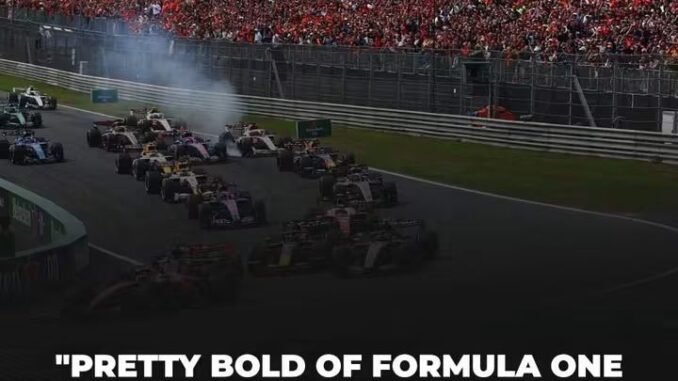
George Russell delivered exactly what Mercedes needed at Zandvoort, converting pole position into victory in Saturday’s Dutch Grand Prix Sprint. But while the result strengthened Russell’s championship campaign, the race itself left many Formula 1 fans asking a much bigger question: Was Zandvoort ever the right circuit for a Sprint race?
Russell led Charles Leclerc and Lando Norris across the finish line after controlling the contest from the front. The Mercedes driver completed the Sprint 1.360 seconds ahead of Leclerc, with Norris third and championship leader Kimi Antonelli fourth.
On paper, it was another important victory for Russell.
In terms of entertainment, however, the race was far less convincing.
ZANDVOORT’S BIGGEST PROBLEM WAS ON FULL DISPLAY
The Circuit Zandvoort is one of Formula 1’s most visually distinctive venues. Its banking, fast corners and narrow layout create an old-school character that many drivers and fans appreciate.
But those same characteristics can make overtaking extremely difficult when cars have similar performance.
That weakness became particularly obvious during the Sprint.
Russell established control at the front early, while Norris initially followed before Leclerc eventually moved ahead of the McLaren on lap 18. Behind them, there was little sustained action capable of dramatically changing the order.
That is why some fans described the event as feeling more like a procession than a genuine Sprint.
And there is an important distinction here: the problem was not necessarily that the drivers failed to race aggressively. The circuit simply offered very few opportunities to create meaningful attacks.
RUSSELL COULD NOT HAVE ASKED FOR A BETTER RESULT
For George Russell, the lack of drama was hardly a complaint.
He executed the weekend perfectly when it mattered.
After taking Sprint pole, Russell made a clean getaway and controlled the race from start to finish. The victory was his third Sprint win of the 2026 season and gave Mercedes another important points haul.
More importantly, the result helped Russell close the gap to Mercedes teammate Kimi Antonelli in the championship.
Antonelli entered the Sprint as the championship leader and finished fourth, while Russell collected the maximum eight points. At that stage of the weekend, Antonelli led Lewis Hamilton by 53 points, with Russell another three points behind Hamilton.
That makes Russell’s victory considerably more significant than the race itself might suggest.
He did not merely win a Saturday exhibition.
He took another step toward keeping himself involved in the championship fight.
LECLERC AND FERRARI FOUND A VALUABLE OPPORTUNITY
Charles Leclerc’s second-place finish was another positive development for Ferrari.
The Ferrari driver started behind Russell but eventually found a way past Norris for second. His result demonstrated that Ferrari had enough race pace to challenge McLaren, at least over the Sprint distance.
Leclerc’s tyre choice also proved important, with Ferrari taking a calculated approach that helped him move ahead of Norris.
That could have wider significance for the Grand Prix.
Zandvoort rewards track position, and overtaking is not easy. That means qualifying performance, tyre management and pit-stop timing can become disproportionately important.
Ferrari therefore had reasons to be encouraged even without taking the win.
NORRIS HAD SPEED, BUT THE SPRINT EXPOSED A WEAKNESS
Lando Norris had started from the front row alongside Russell, yet he ultimately had to settle for third.
The result raised questions about McLaren’s Sprint pace compared with Mercedes.
Norris later secured pole for Sunday’s Grand Prix, showing that the McLaren had plenty of one-lap performance. But the Sprint suggested that qualifying speed and long-run performance were not necessarily the same thing at Zandvoort.
That distinction became one of the biggest talking points heading into the main event.
Norris could start first, but could he maintain the advantage once tyre degradation and race strategy entered the equation?
That was the question Mercedes had to answer.
ANTONELLI’S FOURTH PLACE MATTERED MORE THAN IT LOOKED
Kimi Antonelli did not have the headline result, but fourth place was still useful in the championship.
The Mercedes rookie arrived at Zandvoort with a substantial advantage over his closest rivals. Russell’s Sprint victory reduced that cushion, but Antonelli still walked away with points.
That is exactly how championship battles are often decided.
A driver does not need to win every weekend. Avoiding major losses on difficult days can be just as important.
Antonelli’s fourth place therefore represented damage limitation.
Russell, meanwhile, had every reason to believe the championship fight was becoming more interesting.
HAMILTON’S RESULT CREATED ANOTHER QUESTION FOR FERRARI
Lewis Hamilton finished seventh in the Sprint, collecting two points.
That was hardly the result Ferrari would have wanted from a driver who remained one of Antonelli’s principal championship challengers at that stage of the weekend.
Hamilton had been expected to fight toward the front, but the Sprint once again demonstrated how small the margins were between Ferrari, Mercedes and McLaren.
The seven-time world champion therefore needed a much stronger performance in the Grand Prix if he wanted to keep pressure on the Mercedes drivers.
THE RAIN ARRIVED TOO LATE TO CHANGE EVERYTHING
Perhaps the most frustrating element for fans was the weather.
Rain arrived around the conclusion of the Sprint, creating the possibility of the kind of unpredictability that could have completely changed the race.
But by then, Russell had already done the important work.
Had the rain become heavier earlier, drivers could have faced a completely different situation involving tyre choices, reduced grip and greater uncertainty.
Instead, the weather arrived almost as a tease.
It showed viewers what might have happened without actually changing the outcome.
THE REAL PROBLEM WITH SPRINT RACES IS CIRCUIT SELECTION
This Sprint should not automatically be used as evidence that the entire Sprint format has failed.
There are circuits where the shorter format works extremely well.
A Sprint can create spectacular racing when drivers have multiple overtaking zones, strategic options and enough variation in tyre performance to force competitors into different approaches.
Zandvoort is a much tougher proposition.
Its narrow nature means that when several cars have similar pace, the driver behind can struggle to get close enough to attempt a pass.
That makes the opening laps and qualifying position enormously important.
And that is potentially the exact opposite of what F1 wants from a Sprint.
ZANDVOORT’S FAREWELL MAKES THE DEBATE EVEN MORE INTERESTING
There is also an unusual historical element surrounding this particular weekend.
The 2026 Dutch Grand Prix was Zandvoort’s final scheduled F1 race for the foreseeable future. The circuit returned to the calendar in 2021 after a long absence and quickly became one of the sport’s most distinctive venues, particularly because of its enormous Verstappen-supporting crowd.
So there was always going to be an emotional component to this weekend.
Zandvoort deserved its farewell.
But its popularity does not necessarily mean it is the ideal venue for every format F1 wants to introduce.
A circuit can be spectacular without producing constant overtaking.
Those are two completely different qualities.
WHAT THIS MEANS FOR THE CHAMPIONSHIP
Russell’s Sprint victory mattered because the 2026 title fight remains extremely tight behind Antonelli.
At the time of the Sprint, Antonelli had 224 points, Hamilton 171 and Russell 168. Russell’s eight-point haul therefore moved him closer to Hamilton while trimming Antonelli’s advantage.
For Mercedes, that is both encouraging and potentially complicated.
The team has two drivers capable of fighting near the front, but as the championship becomes tighter, internal competition becomes increasingly important.
Every point Russell takes from Antonelli is a point that potentially changes the balance of the title battle.
MY TAKE: THE SPRINT NEEDED A DIFFERENT VENUE
There is nothing wrong with Russell’s victory.
In fact, Mercedes should be delighted.
He started from pole, managed the tyres, controlled the pace and delivered eight valuable points. That is exactly what a championship contender is supposed to do.
The problem is that the race did not give the drivers enough opportunities to show what they could do.
For me, that is the biggest lesson from Zandvoort.
F1 should not simply ask whether a circuit is popular enough to host a Sprint. It should ask whether the track can actually produce the type of racing the Sprint format promises.
If the answer is no, a conventional Grand Prix may be a better fit.
THE BIGGER QUESTION F1 MUST ANSWER
Formula 1 wants Sprint weekends to create more excitement, more competitive sessions and more reasons for fans to watch throughout the weekend.
But quantity cannot replace quality.
Adding another race only works when that race has the ingredients necessary to produce genuine competition.
Zandvoort showed the danger of getting that calculation wrong.
Russell’s victory was important. Leclerc’s second place was impressive. Norris remained firmly in the fight. Antonelli protected his championship lead.
But the lasting conversation was about what the Sprint failed to produce.
And that may ultimately be the most valuable lesson from the final Zandvoort Sprint: if F1 wants fans to embrace the format, it needs to put it on circuits where drivers can actually race each other.
Zandvoort may be leaving the calendar after a memorable final weekend, but the debate over Sprint circuit selection is likely to continue long after the Orange Army has gone home.
Leave a Reply