
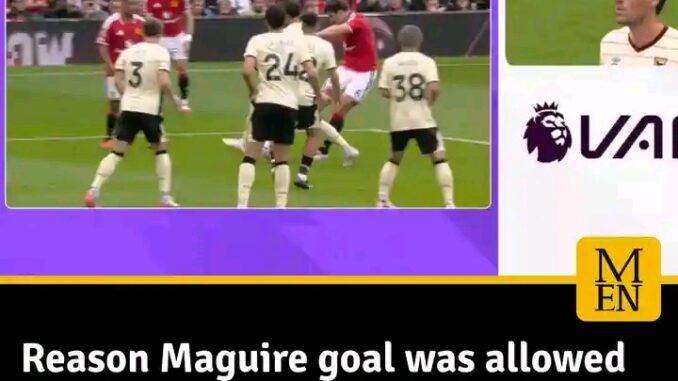
A controversial moment involving Manchester United has sparked intense debate after Harry Maguire’s goal was allowed to stand despite claims that a handball had occurred during the build-up. The decision immediately attracted attention from supporters, pundits and football fans, with many questioning how the officials reached their conclusion.
 The incident unfolded during a tense passage of the match, when Manchester United pushed forward in search of a decisive breakthrough. The ball appeared to make contact with a United player’s hand before the move eventually resulted in Maguire finding the back of the net. With the handball seemingly visible to the officials, questions quickly emerged over why the goal was not ruled out.
The referee’s decision to allow the goal created confusion inside the stadium. Players from the opposing side immediately appealed for a handball, while Manchester United players celebrated Maguire’s finish. The contrasting reactions highlighted just how significant the decision could become.
Attention then turned to the video assistant referee and the review process. Under the laws of the game, not every contact between the ball and a player’s hand or arm automatically constitutes an offence. Officials must determine factors such as the position of the arm, the nature of the contact and whether the player deliberately handled the ball.
That distinction appears to be central to why Maguire’s goal was permitted to stand. Even if the ball touched a Manchester United player’s hand, the officials may have judged that the contact did not meet the threshold for a punishable handball. A visible touch, therefore, does not necessarily mean that a goal must automatically be cancelled.
Another important consideration is whether the handball occurred immediately before the goal and whether it materially affected the attacking move. VAR officials are required to examine the sequence carefully rather than simply reacting to an isolated frame showing the ball touching an arm.
The controversy intensified because supporters felt the referee had already seen the incident. However, seeing an incident and determining that it is an offence are two different things. The referee can acknowledge the contact while simultaneously deciding that it does not constitute a handball under the laws of the game.
For Manchester United, the decision ultimately meant that Maguire’s contribution remained on the scoresheet. The defender, who has often found himself at the centre of major moments, once again became the focus of widespread discussion after producing a finish that could prove crucial.
Opposing supporters, however, were far from satisfied. Many argued that the apparent handball should have been enough to disallow the goal, particularly because it occurred during the attacking sequence. Social media quickly filled with competing interpretations of the footage, with fans presenting different angles to support their arguments.
The situation also renewed the broader debate about consistency in handball decisions. Similar incidents have previously produced different outcomes, leaving supporters frustrated about what they believe is an unclear application of the rules.
Ultimately, the goal was allowed because the officials apparently determined that the handball element did not constitute a punishable offence under the applicable laws. The controversy may continue, but the official decision remains that Maguire’s goal stands.
The incident is another reminder of how fine the margins can be in modern football. With VAR reviewing increasingly detailed situations, supporters expect decisions to be consistent and transparent, particularly when a goal appears to have been affected by a possible handball.
For now, Manchester United can take the result while their opponents are left questioning the officiating. Maguire’s goal has therefore become much more than a simple finish—it has become the centre of a major refereeing debate that could continue lon g after the final whistle.
Leave a Reply