
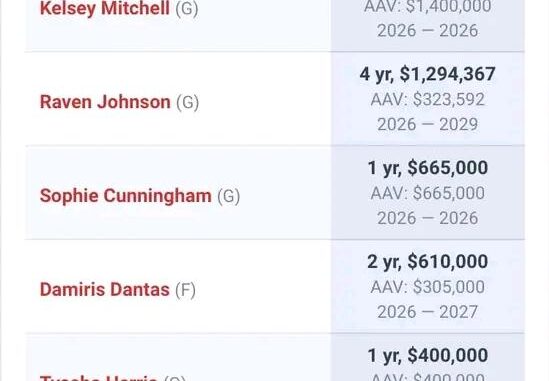
Looking at the Indiana Fever’s 2026 payroll under the new collective bargaining agreement paints a clear picture of who management is likely to keep and who could be on the move this offseason.
The numbers jump out. Tyasha Harris is pulling in $400,000 on a one-year deal. Rookie Raven Johnson’s average annual value sits around $324,000 (user figure of $332k is close enough), even while spending significant time on the bench. Caitlin Clark, still on the adjusted rookie scale, checks in far lower relative to her impact at roughly the old-era numbers fans still cite near $84k before the CBA reset—though her actual 2026 figure is higher under the new rules.
That gap is the new normal. The CBA exploded the salary cap from about $1.5 million to $7 million, lifted the minimum near $300k, and pushed average pay toward $600k. Suddenly a bench role at $300k-plus is solid money rather than a slight.
For the front office the calculus is straightforward. Core pieces under longer deals—Aliyah Boston on her record extension and Clark with her 2027 option already exercised—are locks to stay. Kelsey Mitchell’s one-year supermax makes her a priority to re-sign if the team wants continuity.
Harris at $400k for limited production becomes a harder sell in a tighter future cap. Expect her to test free agency or accept a reduced role elsewhere. Raven Johnson’s multi-year rookie deal gives Indiana cheap depth and development upside; keeping her is low-risk. Veterans on expiring one-year contracts (Sophie Cunningham, Myisha Hines-Allen) will face sharper scrutiny—productive rotation players may return on team-friendly deals, while pure bench pieces could be let go to create space.
The Fever enter the offseason already over the current cap in some projections and staring at rising numbers for their stars. Smart retention of the young core plus selective pruning of higher-priced role players looks like the path. Under the new CBA, even the bench is better paid—but only the right fits will stick around.
Leave a Reply