
The Indiana Fever entered their matchup with the Washington Mystics knowing that every game mattered.
Instead of strengthening their position in the WNBA playoff race, Indiana delivered one of its most disappointing performances of the season.
The Fever fell 77-?? to Washington, producing an offensive performance that raised questions about preparation, execution and the team’s ability to handle pressure at the most important stage of the regular season.
Caitlin Clark finished with 25 points, but she struggled to find her rhythm, shooting 6-for-20 from the field and committing five turnovers. Indiana as a team shot just 36.6% from the floor and 21.4% from three-point range.
The defeat also ended the Fever’s three-game winning streak and their run of four consecutive games scoring at least 100 points.
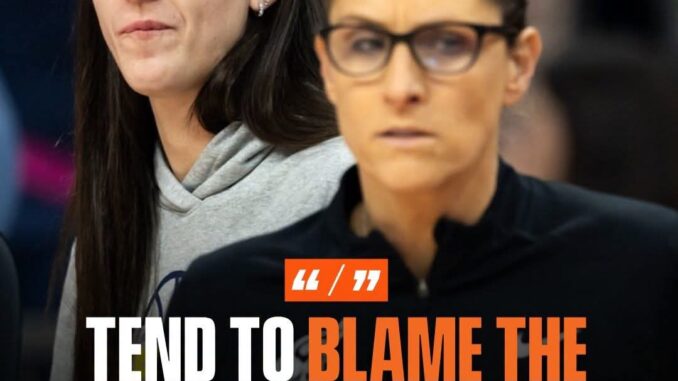
For former ESPN host Linda Cohn, the performance raised questions about the coaching staff.
LINDA COHN QUESTIONS INDIANA’S PREPARATION
During an episode of the Linda Cohn Show, Cohn argued that Indiana’s lack of energy and preparation reflected on the coaching staff.
Her comments focused on the team’s slow start and overall performance rather than simply blaming Clark for her inefficient shooting night.
That distinction is important.
Clark certainly struggled, but Indiana’s problems extended throughout the lineup. The Fever struggled to generate consistent offense, had difficulty against Washington’s defense and never appeared to establish the rhythm that had characterized their recent winning streak.
Cohn’s assessment is her opinion, rather than an established conclusion about the cause of the defeat.
Nevertheless, it highlights a question Indiana cannot ignore: Was the team adequately prepared for a game with major playoff implications?
CAITLIN CLARK COULD NOT CARRY THE FEVER BY HERSELF
Clark’s 25-point performance might look respectable at first glance, but the efficiency tells a different story.
She converted only six of her 20 attempts from the field and shot 30% from three-point range while committing five turnovers.
For a player who frequently serves as Indiana’s primary offensive engine, those numbers naturally attract attention.
But reducing the loss to Clark’s shooting would miss the larger problem.
The Fever scored only 77 points.
Against one of the league’s better defensive teams, Indiana struggled to consistently create clean opportunities. When shots stopped falling, the Fever did not find enough alternative ways to generate offense.
That is precisely why Clark’s workload and supporting cast matter.
A team competing deep into the postseason cannot depend on one player to solve every offensive problem.
STEPHANIE WHITE ALREADY ACKNOWLEDGED THE PRESSURE
Interestingly, Fever head coach Stephanie White’s postgame comments suggest that she was fully aware of the importance of the matchup.
White described every remaining game as effectively having a playoff-level intensity.
She emphasized preparation, defensive assignments, personnel awareness and the need for Indiana to embrace a more physical style of basketball.
That creates an important contrast with Cohn’s criticism.
While Cohn questioned whether the team was sufficiently prepared, White publicly acknowledged that preparation and intensity needed to improve.
The bigger question is therefore not simply whether the coaching staff understands the stakes.
It is whether that understanding is translating into consistent execution on the floor.
WASHINGTON EXPOSED INDIANA’S OFFENSIVE PROBLEMS
One of the biggest takeaways from the defeat was how effectively Washington disrupted Indiana’s offense.
The Fever had recently been putting up huge scoring numbers, including four straight games with at least 100 points.
That streak made the 77-point showing particularly striking.
Washington forced Indiana into difficult possessions and prevented the Fever from finding their normal offensive rhythm.
The three-point shooting was especially damaging.
Indiana made just 21.4% of its attempts from beyond the arc, eliminating one of the team’s most important ways of creating offensive separation.
When a team struggles that badly from outside, the offense must find other solutions.
Indiana couldn’t do enough of that against Washington.
THE PLAYOFF SEEDING RACE HAS BECOME MUCH TIGHTER
The loss also carried significant consequences in the standings.
Indiana fell one game behind the Atlanta Dream for the No. 4 seed, meaning home-court advantage is now under greater pressure.
That matters because finishing fourth would give the Fever home-court advantage in the opening round of the playoffs.
The margin for error has therefore become extremely small.
Indiana cannot simply look at the loss to Washington as one bad night and move on without learning from it.
The remaining games have direct implications for where the Fever begin their postseason journey.
THE POSSIBILITY OF FALLING FURTHER ADDS PRESSURE
The situation could become even more complicated if Indiana loses its remaining games while teams behind it continue winning.
Based on the scenario outlined in the original report, the Fever could potentially fall as low as eighth if the necessary combination of results occurs.
That would dramatically change the team’s postseason circumstances.
Instead of entering the playoffs with home-court advantage, Indiana could find itself starting the postseason on the road.
For a young team trying to establish itself as a serious contender, that difference could be significant.
CAITLIN CLARK’S POSTGAME MESSAGE WAS TELLING
Clark’s comments after the defeat reflected the frustration of the entire team.
Rather than dismissing the loss, she acknowledged that Indiana needed to examine what went wrong.
She described the team’s performance as flat and said the Fever appeared tired and lacked their usual energy.
That response is particularly relevant because it suggests the players themselves understood that the performance was below their normal standard.
The challenge now is turning that disappointment into adjustments.
Every team experiences poor shooting nights.
The more concerning issue is whether Indiana can prevent one bad performance from becoming a pattern.
WHAT THE FEVER NEED FROM CLARK
Clark does not need to shoot perfectly for Indiana to win.
In fact, one of the most important lessons from this loss may be that the Fever need a more balanced offensive identity.
Clark is at her most dangerous when she can combine scoring with playmaking, pull defenders away from teammates and control the pace of the game.
If opponents can force her into difficult shots while simultaneously disrupting Indiana’s supporting options, the Fever become much easier to defend.
That is where the coaching staff and the rest of the roster become crucial.
Indiana needs multiple reliable offensive options when Clark’s shot isn’t falling.
THE COACHING QUESTION IS BIGGER THAN ONE LOSS
Criticism of coaching naturally becomes louder after a disappointing defeat.
But judging an entire coaching staff based on one game would ignore the broader season.
White and her staff have to be evaluated over the team’s overall preparation, rotations, defensive adjustments, offensive schemes and ability to respond to different opponents.
At the same time, the timing of this loss makes the questions understandable.
The Fever are approaching the postseason, and there is little room for repeated performances in which the team looks disconnected offensively.
The answer will ultimately come from how Indiana responds.
THE FEVER HAVE A CHANCE TO RESPOND IMMEDIATELY
The good news for Indiana is that the regular season isn’t over.
The Fever still have an opportunity to recover their position and enter the postseason with momentum.
That makes the response to the Washington loss more important than the loss itself.
If Indiana returns to its high-energy style, improves its shooting and gets stronger contributions around Clark, the Washington game could eventually become nothing more than an unpleasant memory.
If similar problems continue, however, the defeat could be viewed as an indication of deeper issues.
WHY THE NEXT GAMES MATTER FOR INDIANA
At this stage of the season, there is no luxury of treating games as ordinary.
Every possession can affect playoff positioning.
Every defensive breakdown can have postseason consequences.
Every cold shooting night puts additional pressure on the defense and playmaking.
That is why White’s emphasis on preparation and intensity is so important.
The Fever don’t necessarily need spectacular basketball every night.
They need reliable basketball.
They need to execute when shots aren’t falling, defend without losing focus and maintain their composure when opponents make runs.
WHAT THIS MEANS FOR CAITLIN CLARK’S SECOND SEASON
Clark’s second season has already generated enormous attention, but the postseason will provide another test of her development.
The best players eventually learn how to influence games even when their shots aren’t falling.
That can mean creating opportunities for teammates, controlling tempo, defending with discipline and making the right decision under pressure.
The Washington game offered a reminder that even an elite offensive talent can be neutralized for stretches.
How Clark and the Fever respond will be one of the more interesting storylines to watch as the playoffs approach.
FINAL THOUGHTS
The Indiana Fever’s loss to the Washington Mystics was far more consequential than a routine regular-season defeat.
Indiana’s offense stalled, its shooting disappeared and the team failed to match Washington’s defensive intensity.
Caitlin Clark struggled, but the defeat cannot fairly be placed entirely on her shoulders.
Linda Cohn’s criticism has sparked a conversation about Indiana’s preparation and coaching, while Stephanie White’s own postgame comments show that the Fever’s staff understands the urgency surrounding the team.
Now comes the most important part: the response.
The Fever still have time to recover their playoff positioning. But with the postseason approaching, there is no room for repeated performances that leave the team searching for answers.
For Clark, White and the rest of Indiana, the message is simple: learn from Washington, reset quickly and make the next game look very different.
Leave a Reply