
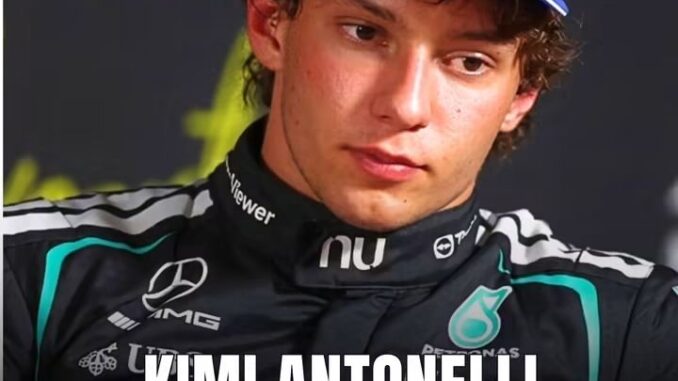
Kimi Antonelli insists he is not feeling the pressure of leading the 2026 Formula 1 championship, but his difficult Dutch Grand Prix weekend has delivered a timely reminder that the title fight can change quickly.
The Mercedes rookie arrived at Zandvoort with a commanding 50-point advantage over Lewis Hamilton, having already collected six victories from the opening 11 races.
Yet the Dutch Grand Prix weekend has been far less straightforward.
Mistakes in Sprint Qualifying and Grand Prix qualifying have prevented Antonelli from maximizing Mercedes’ pace, leaving the championship leader to start the main race from third on the grid rather than fighting for pole.
For a driver chasing what could become a historic world championship, however, Antonelli believes the setbacks are not evidence that he is cracking under pressure.
ANTONELLI’S DOMINANT FIRST HALF OF THE SEASON
Antonelli’s position at the top of the championship is remarkable considering this is his first full Formula 1 season at the highest level.
Six victories in the opening 11 Grands Prix gave the Mercedes driver a substantial cushion before the summer break. That consistency put him firmly in control of the championship battle and raised the possibility of Antonelli becoming the youngest world champion in F1 history.
But leading a championship and finishing it are two very different challenges.
The second half of a season brings a different kind of pressure. Rivals know exactly what they need to attack, teams develop their cars, and every mistake becomes more costly as the number of remaining races decreases.
That is why Zandvoort has provided such an important test for Antonelli.
A ROUGH START AT ZANDVOORT
Antonelli’s weekend immediately became more complicated during Sprint Qualifying.
A trip through the gravel damaged the floor of his Mercedes, affecting his preparation and contributing to a disappointing fifth-place finish in Saturday’s Sprint.
For a driver who had spent much of the first half of the season converting strong qualifying performances into victories, the setback was a noticeable change of rhythm.
It also created another challenge: rebuilding confidence.
Antonelli admitted that the mistake had taken some confidence away, and the feeling of the car was not ideal during qualifying.
That makes his eventual third-place qualifying result more significant.
ANTONELLI COULD HAVE TAKEN POLE
Despite his struggles, Antonelli believes Mercedes had enough performance to challenge Lando Norris for pole position.
The Italian ultimately qualified third, just 0.133 seconds behind Norris and only 0.031 seconds behind Mercedes teammate George Russell.
The margins show just how close the top of the grid was.
Antonelli’s biggest regret came during his final Q3 lap. With rain appearing on his visor, he approached the opening sector too cautiously and lost valuable time.
In a championship where every point matters, that tiny mistake could become more important than it initially appears.
Starting third still gives Antonelli an excellent opportunity to fight for victory, but pole would have placed him in a much stronger position strategically.
THE MOST IMPORTANT WORD: WAKE-UP CALL
Antonelli’s description of the weekend as a “wake-up call” may be more important than the qualifying result itself.
The championship leader acknowledged that Formula 1 punishes complacency.
His mistakes were not necessarily caused by championship pressure. Instead, Antonelli believes they came from briefly lowering his level of concentration.
That distinction matters.
A driver who is overwhelmed by pressure may begin making increasingly defensive or hesitant decisions. A driver who recognizes a mistake, learns from it and immediately resets can come back stronger.
Antonelli appears to believe he belongs in the second category.
THIS IS WHERE THE TITLE FIGHT GETS INTERESTING
The 50-point advantage gives Antonelli breathing room, but it does not make him safe.
Lewis Hamilton remains one of the most experienced drivers on the grid, while Mercedes teammate George Russell is also capable of taking points away from him.
And with the championship entering its decisive phase, momentum could become just as important as the standings.
If Antonelli starts regularly finishing behind Hamilton or Russell, the gap can disappear surprisingly quickly.
On the other hand, another victory at Zandvoort would immediately turn this difficult weekend into a successful one.
That is the fascinating part of Formula 1: a driver can have a frustrating Saturday and still completely change the narrative on Sunday.
MERCEDES HAS AN INTERESTING PROBLEM
Antonelli’s position also creates an intriguing situation for Mercedes.
The team currently has two drivers close enough to influence the championship, but only one is leading it.
Russell’s qualifying performance means he starts ahead of Antonelli, while Hamilton remains an important threat in the wider championship picture.
If the championship battle becomes extremely tight, Mercedes could eventually face difficult strategic decisions about how aggressively it should manage its drivers.
For now, however, there is no obvious reason for the team to interfere.
Antonelli’s 50-point cushion means he remains in control, and Mercedes’ priority should be maximizing its total points rather than creating unnecessary internal tension.
COULD ANTONELLI BECOME THE YOUNGEST F1 CHAMPION?
That possibility is becoming increasingly difficult to ignore.
Antonelli has already demonstrated the most important quality required of a champion: the ability to win consistently.
But a championship is ultimately about managing an entire season rather than producing isolated performances.
The young Italian now needs to show that he can respond to difficult weekends as effectively as he responds to successful ones.
Zandvoort may therefore prove more valuable to his development than another easy victory would have been.
A championship leader who learns how to recover from mistakes can become significantly more dangerous in the final races of the season.
MY TAKE: THIS WEEKEND MAY ACTUALLY HELP ANTONELLI
It sounds strange to say after two qualifying mistakes, but this could be exactly the type of weekend Antonelli needed.
Dominating every weekend can create the illusion that everything will continue going perfectly. Zandvoort has reminded him that Formula 1 requires constant precision.
The encouraging part is that Antonelli recognizes it.
He has not blamed the car, the weather or his championship rivals. Instead, he has accepted that he needs to stay alert and execute when the opportunity arrives.
That is a mature response from a driver still relatively new to the demands of a title campaign.
WHAT TO EXPECT IN THE DUTCH GP
Starting third gives Antonelli a realistic chance of fighting for the win.
Norris will start from pole, with Russell alongside him, meaning the opening lap could immediately become crucial for the championship leader.
Antonelli cannot afford unnecessary risks, but he also cannot afford to be overly conservative.
The ideal response would be a clean, aggressive race that allows him to capitalize on Mercedes’ pace without compromising his championship position.
If he wins, the “wake-up call” narrative will quickly become a footnote.
If he struggles again, however, questions about whether the championship pressure is beginning to affect him will become much louder.
THE CHAMPIONSHIP IS FAR FROM OVER
Antonelli remains in an excellent position, but Zandvoort has demonstrated why nobody should assume the 2026 title is already decided.
A 50-point advantage is valuable, but Formula 1 can change rapidly.
For Antonelli, the objective now is simple: stay focused, minimize mistakes and continue converting Mercedes’ performance into podiums and victories.
His response at Zandvoort could tell us a lot about whether he is merely enjoying an outstanding debut season — or developing into a genuine Formula 1 champion.
For now, Antonelli says the pressure isn’t getting to him.
The next few races will show whether his actions continue to support that claim.
Leave a Reply