
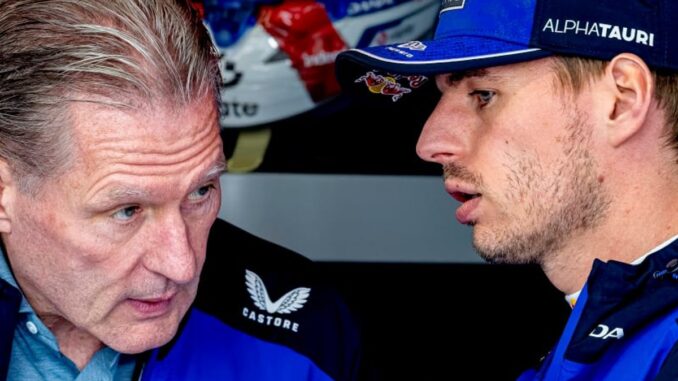
Max Verstappen’s long-term future in Formula 1 appears to be clearer than it has been in months, and his father, Jos Verstappen, has now offered an intriguing hint about how the four-time world champion’s career could eventually end.
Earlier this week, Red Bull Racing and Verstappen confirmed a new agreement that will keep the Dutch driver with the team through the end of the 2030 Formula 1 season. The announcement brings a major chapter of the driver-market speculation to a close after months of questions about whether Verstappen could eventually leave Milton Keynes.
But Jos Verstappen’s latest comments suggest the relationship could go even further than simply honoring the new contract.
VERSTAPPEN FAMILY SIGNALS LONG-TERM COMMITMENT TO RED BULL
Speaking to Viaplay, Jos Verstappen indicated that the family is comfortable continuing its long association with Red Bull.
Jos has been an important figure throughout Max Verstappen’s career, particularly during the driver’s rise from teenage F1 newcomer to four-time world champion. His latest comments therefore carry significance beyond a routine reaction to a contract extension.
The key message is that there appears to be a renewed sense of stability around the Verstappen-Red Bull relationship.
After a period filled with speculation about Max’s future, Jos suggested that continuing with Red Bull until 2030 now feels like the natural path.
That does not necessarily mean Max has formally announced that 2030 will be the final year of his career. However, it raises the possibility that Verstappen could spend the majority — and potentially all — of his remaining F1 career with the same team that helped him become a world champion.
WHY MAX VERSTAPPEN’S 2030 DEAL MATTERS
Verstappen committing to Red Bull until 2030 is significant because the driver has previously been linked with potential moves elsewhere, particularly during periods when Red Bull appeared vulnerable competitively.
Formula 1 is entering a new era of technical regulations, and Red Bull faces the challenge of developing a power unit and chassis package capable of keeping Verstappen at the front.
That makes the contract more than just a commitment from a driver.
It is also a major vote of confidence in Red Bull’s ability to rebuild.
Verstappen has already demonstrated that he is willing to stay loyal to the team despite periods of uncertainty. The bigger question now is whether Red Bull can give him a car worthy of that loyalty.
JOS VERSTAPPEN PUTS THE PRESSURE ON RED BULL
While Jos sounded pleased about the agreement, his message also contained a clear warning.
The expectation is simple: Max Verstappen wants to win.
That means Red Bull cannot afford to treat the 2030 agreement as a guarantee that its star driver will remain satisfied regardless of results.
Verstappen is still in his prime, and another several years without a consistently competitive car would inevitably create questions about whether the partnership is delivering what both sides want.
Jos effectively placed responsibility on Red Bull to produce a strong car for the future.
That pressure could become particularly important as McLaren, Mercedes and Ferrari continue to fight for control of the new-generation F1 era.
COULD MAX ACTUALLY RETIRE AFTER 2030?
This is where Jos Verstappen’s comments become particularly interesting.
If Max remains with Red Bull through 2030, he will be well into his 30s by the end of that season. While that would still leave the door open for several more years in Formula 1, it would also represent an unusually long career for a driver who entered the sport at such a young age.
Max has never appeared to be motivated purely by longevity or chasing records. His career has consistently been centered around competition and winning.
That makes 2030 a potentially logical decision point.
If Red Bull remains competitive and Max is still enjoying F1, he could continue. But if he feels he has accomplished what he wanted, particularly after potentially adding more championships to his collection, retirement could become a realistic option.
Jos’s comments therefore shouldn’t be interpreted as confirmation that Max will retire in 2030. Instead, they make it easier to imagine a scenario where Red Bull becomes the final team of his career.
RED BULL’S BIGGEST CHALLENGE IS NOW PERFORMANCE
The contract extension solves one major problem for Red Bull: uncertainty over its most valuable driver.
Now the focus shifts entirely toward performance.
Keeping Verstappen is only half the battle. Red Bull needs to develop a package capable of putting him in championship contention consistently.
The team has already shown it can build dominant cars, but Formula 1’s competitive landscape is constantly changing. McLaren and Mercedes have demonstrated strong potential, while Ferrari remains a major force with the resources and history to fight at the front.
If Red Bull gets its next generation of cars right, Verstappen could become the centerpiece of another championship era.
If it gets things wrong, the pressure surrounding the 2030 commitment will only increase.
WHAT THIS MEANS FOR THE F1 DRIVER MARKET
Verstappen’s decision also has consequences beyond Red Bull.
For months, the possibility of Verstappen becoming available created one of the biggest storylines in the driver market. His commitment now removes the sport’s most coveted potential free agent from the equation.
That gives rival teams greater clarity when planning their own futures.
Mercedes, Ferrari and McLaren can now focus on developing their existing driver structures rather than preparing for a potential Verstappen arrival.
It also strengthens Red Bull’s position when negotiating with other key personnel. Having the team’s biggest star locked in long-term provides stability during a period of significant technical change.
THE 2030 CONTRACT COULD BECOME THE START OF ANOTHER VERSTAPPEN ERA
There is an interesting possibility here.
If Red Bull manages to produce another dominant generation of cars, Verstappen could spend the final years of his career fighting for championships with the organization that gave him his first title.
That would create a remarkable full-circle story.
He joined Red Bull’s senior team in 2016 as a teenager and quickly became one of the sport’s defining drivers. His first world championship arrived in 2021, followed by three more titles.
A career-ending chapter with Red Bull would therefore have considerable historical weight.
Instead of moving between multiple championship-winning teams, Verstappen could potentially become one of the rare modern F1 champions to spend virtually his entire championship-winning career with one organization.
MY TAKE: RED BULL HAS EVERYTHING TO LOSE NOW
From my perspective, the most important part of this story isn’t whether Max retires in 2030.
It is that Red Bull now has no excuse.
The team’s greatest asset has made a long-term commitment at a time when the competitive order is changing. Verstappen is effectively telling the organization that he believes it can build something capable of winning again.
Now Red Bull has to prove him right.
If the team produces championship-caliber machinery, this deal could eventually be remembered as the foundation of another Verstappen dynasty.
If it doesn’t, questions about whether Max made the right decision will inevitably become louder.
WHAT COULD HAPPEN NEXT?
The most likely scenario is that Verstappen remains Red Bull’s central figure throughout the second half of the decade while the team works to maximize the opportunities created by the new technical era.
If Red Bull returns to the front, Verstappen could add several more victories and potentially multiple championships before 2030.
And if he reaches the end of that contract with another handful of titles, Jos Verstappen’s comments may look remarkably prophetic.
For now, however, retirement remains speculation.
What is certain is that Max Verstappen has chosen stability with Red Bull — and that decision could shape the Formula 1 championship battle for years to come.
Leave a Reply