
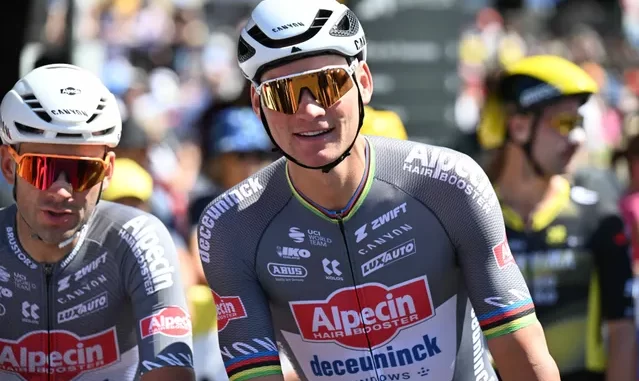
Reports from leading cycling outlets have revealed a striking financial disparity between two of the sport’s most prominent teams — Mathieu van der Poel’s **Alpecin-Deceuninck** and **UAE Team Emirates**, led by Tour de France champion Tadej Pogačar. According to sources close to the UCI and several European sports finance reports, Alpecin-Deceuninck operates with an estimated annual budget of **€27 million**, roughly half of the staggering **€55 million** enjoyed by UAE Team Emirates.
While Alpecin-Deceuninck has become one of the most successful ProTeams in recent years, consistently competing toe-to-toe with WorldTour giants, this revelation underscores the massive financial gap that continues to shape modern cycling. Despite their smaller budget, the Belgian squad has managed to secure victories across the biggest one-day races and even Grand Tour stages — largely thanks to the explosive brilliance of Van der Poel, whose versatility and star power have elevated the team’s global profile far beyond its monetary limitations.

Industry insiders have noted that Alpecin-Deceuninck’s budget reflects a sharp contrast in resources compared to powerhouse teams like UAE, INEOS Grenadiers, and Jumbo-Visma (now Visma–Lease a Bike). Those teams operate with corporate-backed sponsorships and multimillion-euro training programs, while Alpecin-Deceuninck’s funding relies heavily on targeted partnerships and the marketing appeal of Van der Poel himself, who remains one of the most marketable athletes in cycling today.
Team management has acknowledged the financial gap but insists that the squad’s success stems from efficiency, strategy, and a culture built on performance rather than spending power. “We may not have the biggest budget,” a senior Alpecin official reportedly said, “but we invest every euro in riders and staff who believe in our vision. Results speak louder than money.”
Indeed, that philosophy has paid off spectacularly. In the past two seasons alone, Alpecin-Deceuninck riders have delivered victories in the Tour of Flanders, Paris-Roubaix, Milan-San Remo, and multiple Grand Tour stages. Van der Poel’s commanding win at the 2024 World Championships and his dominant performances in the Classics have proven that strategic planning and team chemistry can rival — and even surpass — financial muscle.
Analysts argue that the €27 million figure further highlights Van der Poel’s immense influence, as his personal brand attracts sponsorships, merchandise sales, and fan engagement levels usually reserved for riders in teams with double the funding. His versatility across disciplines — road racing, cyclocross, and mountain biking — has transformed Alpecin-Deceuninck into a global name, proving that excellence and innovation can close even the widest financial gap.
Still, some observers warn that maintaining top-tier competitiveness on a smaller budget could become increasingly difficult as the sport evolves. Rising salaries, technology costs, and support infrastructure demand significant investment, and without additional sponsors, Alpecin-Deceuninck may eventually struggle to match the spending power of the elite few.
For now, though, the team’s achievements continue to defy expectations. Fans see Van der Poel’s story as a reminder that talent, teamwork, and vision can outperform deep pockets — a sentiment that has made him not just a champion, but a symbol of what cycling still represents at its core.
As one Dutch commentator summed it up: “€27 million may be half of UAE’s budget, but in terms of heart, ambition, and legacy, Alpecin-Deceuninck is already richer than most.”
Leave a Reply